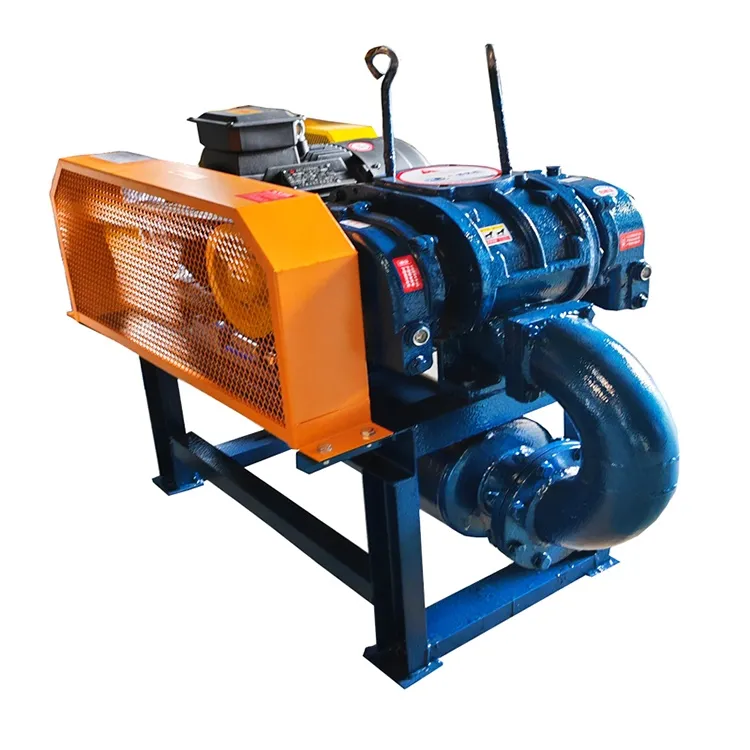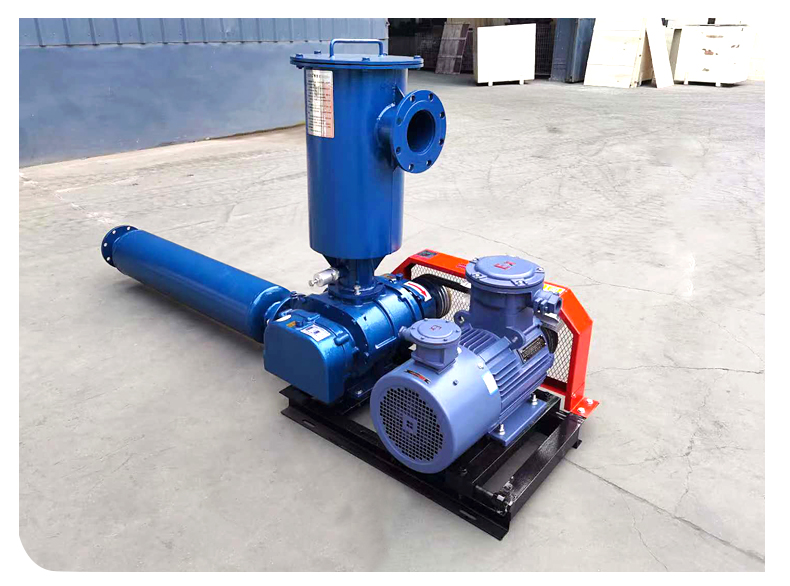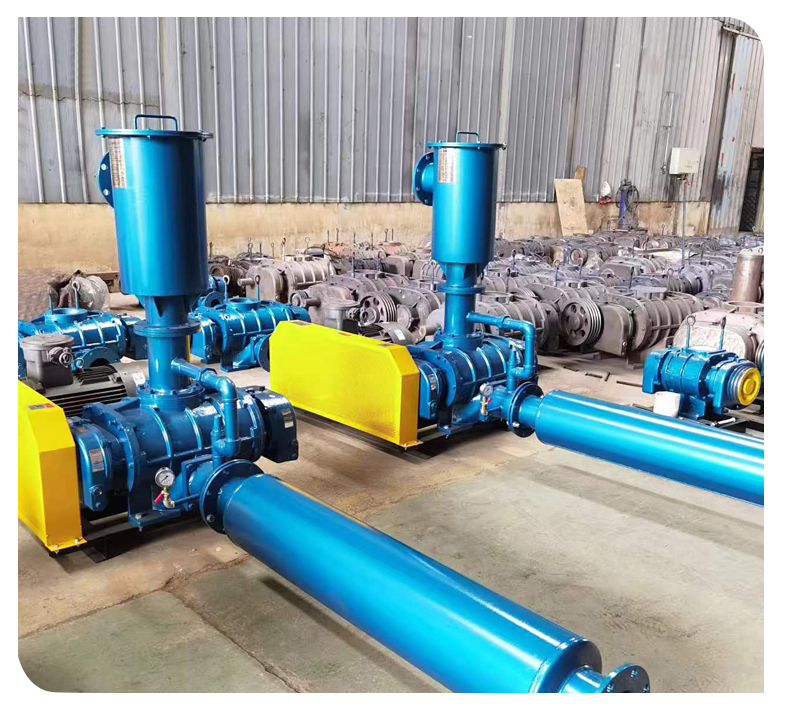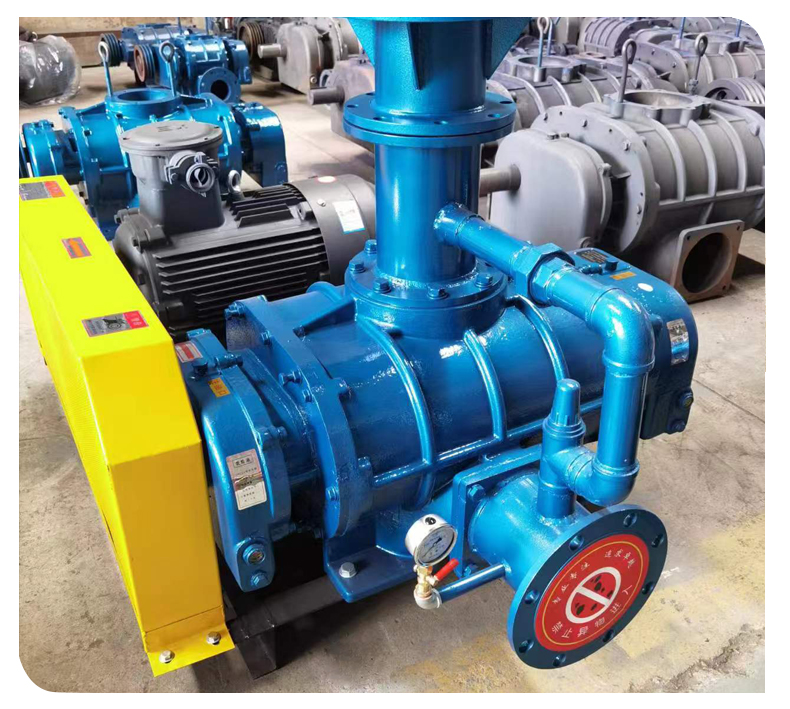
The core working principle of Roots blower is based on volumetric gas compression and delivery, which achieves gas suction, compression, and discharge through two specially designed rotors rotating synchronously in reverse within the cylinder. The core mechanism can be decomposed into the following key steps:
1、 Rotor Structure and Motion Principle
Rotor shape
Adopting an involute “8” – shaped (or three leaf shaped) rotor, the surface is smooth without protrusions, and a small gap (usually 0.1-0.5mm) is maintained between the rotor and the cylinder inner wall, as well as between rotors.
Advantages of a three bladed rotor: Compared to a two bladed rotor, the suction and exhaust frequencies are increased by 50%, vibration is reduced by 40%, noise is reduced by 10-15 dB (A), and the operation is smoother.
Synchronous reverse rotation
The two rotors are driven by a pair of high-precision synchronous gears, ensuring opposite rotation directions and the same angular velocity, maintaining a constant gap between the rotors, and avoiding contact wear.
2、 Gas compression and transportation process
Inhalation stage
When the rotor rotates to the intake port, a negative pressure zone is formed between the cylinder and the rotor, and the external gas enters the cylinder through the filter under the pressure difference.
As the rotor continues to rotate, the gas is gradually enveloped within the enclosed volume formed by the rotor and cylinder.
Compression stage
The enclosed volume moves towards the exhaust port as the rotor rotates, gradually decreasing in volume and compressing the gas.
Key feature: Roots blower is used for forced gas delivery, and the compression process does not rely on the direct force between the rotor and the gas, but is achieved through volume changes. Therefore, pressure changes have minimal impact on flow rate.
Exhaust stage
When the enclosed volume is connected to the exhaust port, high-pressure gas is quickly discharged.
Pressure mutation mechanism: At the moment of exhaust, high-pressure gas flows back to the rotor gap, causing a sudden increase in pressure within the volume to the system pressure, completing gas delivery.
3、 Core design features
No internal compression process
Gas compression does not significantly occur during the rotation of the rotor, and the main pressure increase depends on the high-pressure gas reflux from the exhaust port. Therefore, Roots blowers belong to external compression models.
Advantages: Simple structure, lower manufacturing accuracy requirements than internal compressor models (such as screw compressors), and lower cost.
Constant flow output
The flow rate is only related to the rotor speed and geometric dimensions, and is not related to the system pressure. It is suitable for scenarios that require stable gas flow (such as sewage treatment aeration).
Oil free lubrication design
The rotors and between the rotors and the cylinder are sealed with precision clearances, without the need for lubricating oil to participate in the compression process. The exhaust gas is clean and oil-free, suitable for fields such as food and medicine.
4、 Dynamic Balance and Vibration Control
dynamic balance design
During the manufacturing process, the rotor undergoes high-precision dynamic balance correction (with a balance accuracy typically reaching G6.3 level) to reduce centrifugal force and vibration during rotation.
Synchronous gear drive
Synchronous gears ensure the accuracy of rotor meshing, with a clearance control error of ≤ 0.05mm, to avoid vibration and noise caused by rotor offset.
Silencer configuration
The exhaust port is equipped with a resistant muffler, which absorbs high-frequency noise through an expansion chamber and perforated plate structure, reducing the noise level to below 85 dB (A).
5、 Relationship between pressure and flow rate
Stress adaptability
The pressure ratio of a single-stage Roots blower is usually less than 1.7 (outlet pressure ≤ 1.5 times inlet pressure), and can reach up to 2.1.
When higher pressure is required, it can be achieved through multi-stage series connection (such as a two-stage series connection pressure ratio of up to 3.6).
flow regulation
Variable frequency speed regulation: By changing the motor speed to adjust the flow rate, the energy saving rate can reach 20% -30%.
Bypass regulation: Open the bypass valve to release some gas, but the efficiency is low and it is only used as an emergency measure.