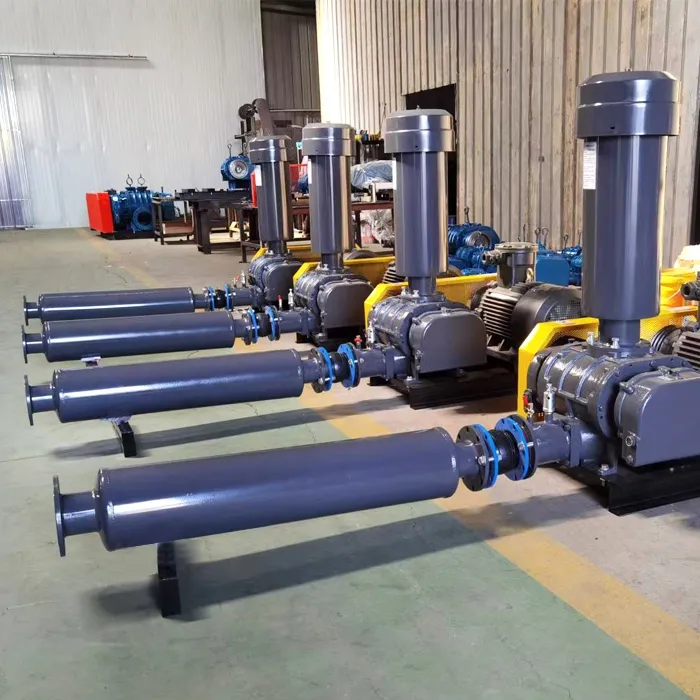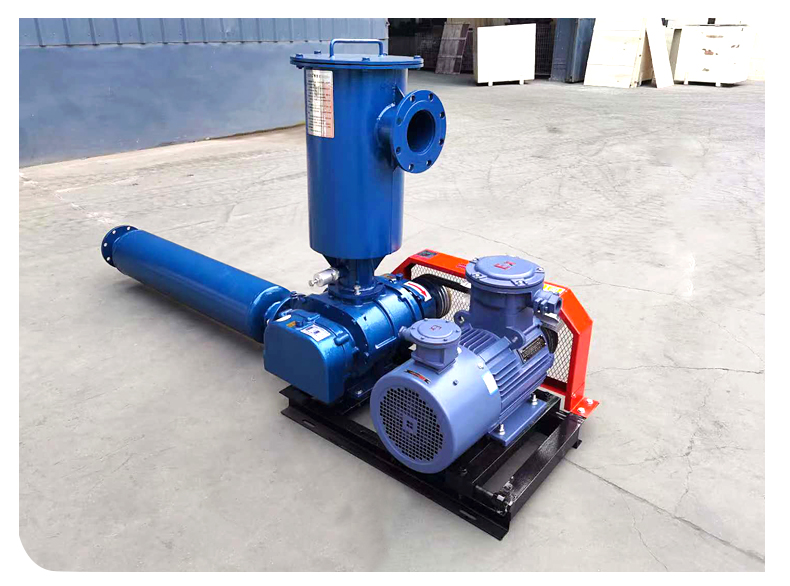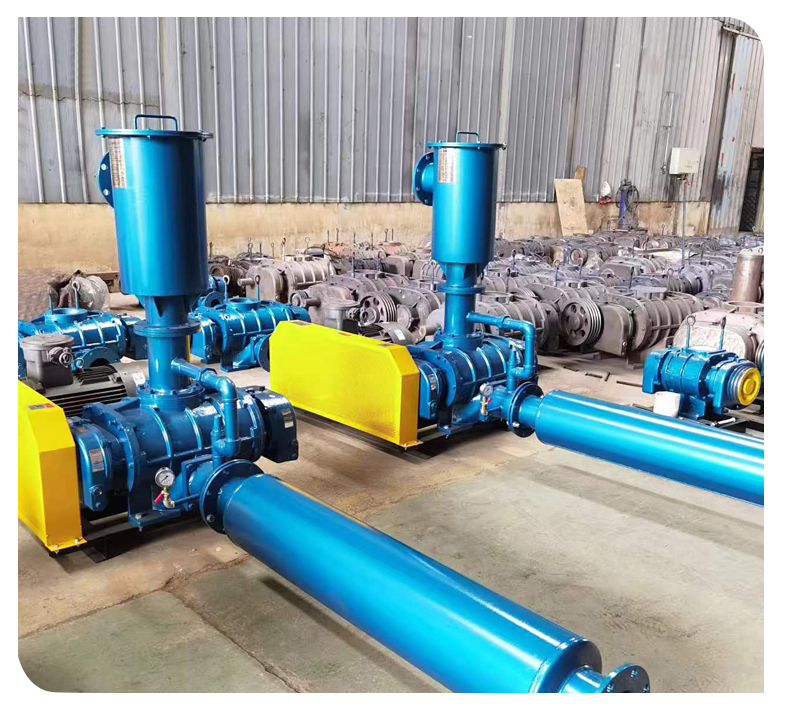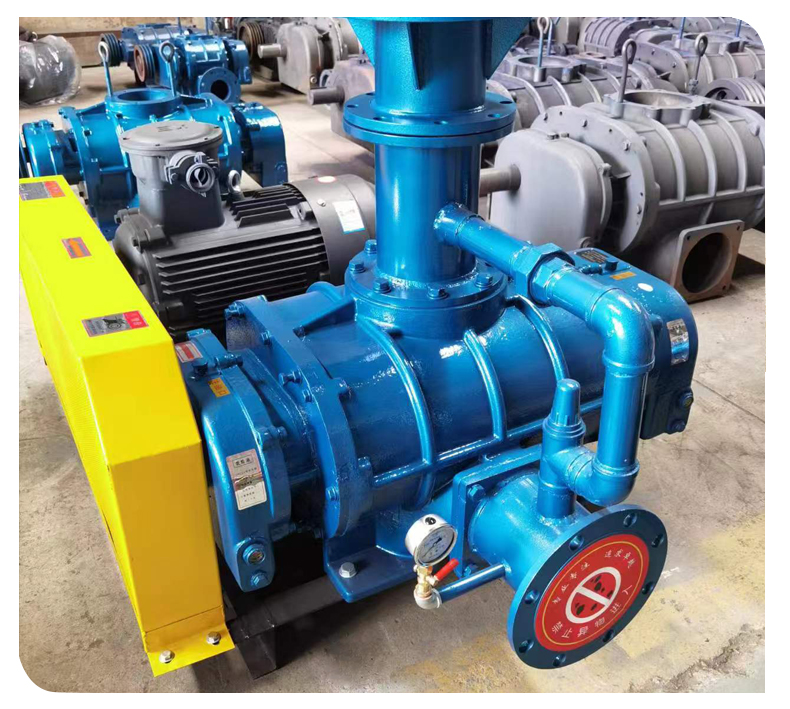
Roots blowers are widely used in industrial fields that require stable gas sources or vacuum environments due to their characteristics of forced gas transmission, constant flow rate, no oil pollution, and strong pressure adaptability. The following is an analysis of its main applicable scenarios and specific application scenarios:
1、 Environmental protection field: sewage treatment and waste gas treatment
Sewage treatment aeration
Function: Provide dissolved oxygen for the aeration tank in the activated sludge process and promote microbial decomposition of organic matter.
Advantage:
Stable flow rate, fluctuation of dissolved oxygen content ≤ ± 0.5 mg/L, ensuring treatment efficiency.
Oil free lubrication design avoids lubricating oil pollution of water bodies and meets environmental protection requirements.
Case: Urban sewage treatment plants, industrial wastewater treatment stations (such as chemical and paper industries).
Waste gas treatment and ventilation
Function: Transport dusty and corrosive gases (such as sulfur dioxide and hydrogen chloride) to the scrubbing tower or incinerator.
Advantage:
Corrosion resistant materials (such as stainless steel and fiberglass) are optional to adapt to harsh working conditions.
Can be equipped with explosion-proof motors for handling flammable and explosive gases.
Case: Flue gas treatment in garbage incineration plants, acid mist treatment in electroplating plants.
2、 Aquaculture: oxygenation and water circulation
Micro porous oxygenation system
Function: By using a Roots blower to deliver high-pressure air to the bottom of the pond, small bubbles are formed through a microporous aeration disc to improve dissolved oxygen efficiency.
Advantage:
The dissolved oxygen content can reach 5-8 mg/L, and the breeding density can be increased by 30% -50%.
Energy saving of over 30% (compared to traditional waterwheel aerators).
Case: High density aquaculture (such as shrimp and sea bass), factory based circular aquaculture.
Water circulation and purification
Function: Drive the circulation of water between the aquaculture pond and the filtration system to maintain stable water quality.
Advantage: Constant flow rate, avoiding water quality deterioration caused by flow fluctuations.
3、 Pneumatic conveying: transportation of powder and granular materials
Powder conveying
Function: Convey powdered materials such as cement, flour, starch, plastic particles, etc.
Advantage:
The conveying distance can reach 500m, and the conveying capacity is stable at 10-100 t/h.
Closed conveying to avoid dust leakage and meet environmental protection requirements.
Case: Raw material transportation in cement plants, flour transportation in grain processing plants.
Particle material transportation
Function: Transport coal powder, fertilizer particles, chemical raw materials, etc.
Advantage:
Can transport materials with dust content ≤ 100 mg/m ³ and particle size ≤ 0.1 mm.
Wear resistant design (such as hard alloy rotors) extends equipment life.
Case: Raw material conveying and coal powder boiler feeding system in fertilizer plant.
4、 Vacuum application: Roots vacuum pump combination system
Industrial vacuum packaging
Function: In series with the water ring vacuum pump, form a Roots water ring vacuum unit for rapid vacuuming.
Advantage:
The ultimate vacuum degree can reach -80 kPa, and the pumping rate is high.
Suitable for vacuum packaging in the food and pharmaceutical industries (such as potato chips and pharmaceutical aluminum foil packaging).
Case: Automated vacuum packaging production line, laboratory vacuum drying.
Vacuum treatment in the chemical industry
Function: Used for processes such as vacuum distillation, vacuum concentration, and vacuum dehydration.
Advantage:
Corrosion resistant materials are optional and suitable for acidic and alkaline gas environments.
Can be equipped with variable frequency speed regulation to flexibly control the vacuum degree.
Case: Purification of chemical raw materials, solvent recovery in the pharmaceutical industry.
5、 Energy and Electricity: Gas Transmission and Boiler Combustion Assistance
Gas transmission
Function: Transport combustible gases such as natural gas, biogas, and coal gas to combustion equipment.
Advantage:
Explosion proof design (Ex d Ⅱ CT4 motor) ensures safety.
Stable pressure to avoid combustion fluctuations.
Case: Gas transmission and gasification process gas supply for biogas power plants.
Boiler combustion assistance
Function: To provide combustion air for industrial boilers and improve combustion efficiency.
Advantage:
Constant flow rate ensures sufficient combustion and reduces pollutant emissions.
Can be equipped with a waste heat recovery device to further save energy.
Case: Air supply for boilers in thermal power plants and combustion assistance for heating furnaces in the chemical industry.
6、 Special industry applications
Paper industry: pulp conveying and dewatering
Function: Transport pulp to the forming net or provide a vacuum source for the vacuum dewatering tank.
Advantage:
Moisture resistant environment design, suitable for high humidity working conditions.
Stable flow rate to avoid pulp breakage or uneven dewatering.
Textile industry: Airflow spinning and fabric processing
Function: Provide high-pressure air for air spinning or drive fabric processing equipment (such as setting machines).
Advantage:
Oil free lubrication avoids fiber contamination.
Adjustable pressure to meet different process requirements.
Medical industry: Pneumatic conveying and equipment gas supply
Function: Transport drug powder and drive medical equipment (such as anesthesia machines).
Advantage:
Clean and oil-free, in compliance with GMP standards.
Low noise (≤ 75 dB (A)), suitable for hospital environments.