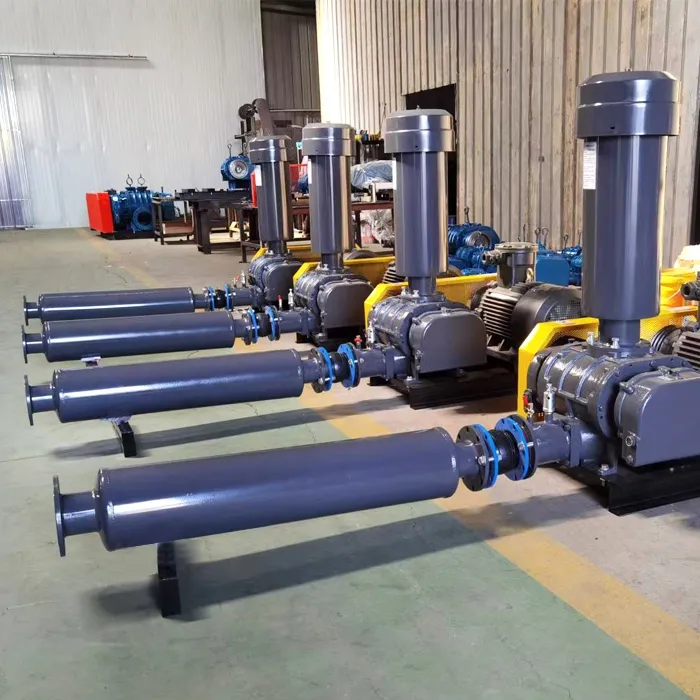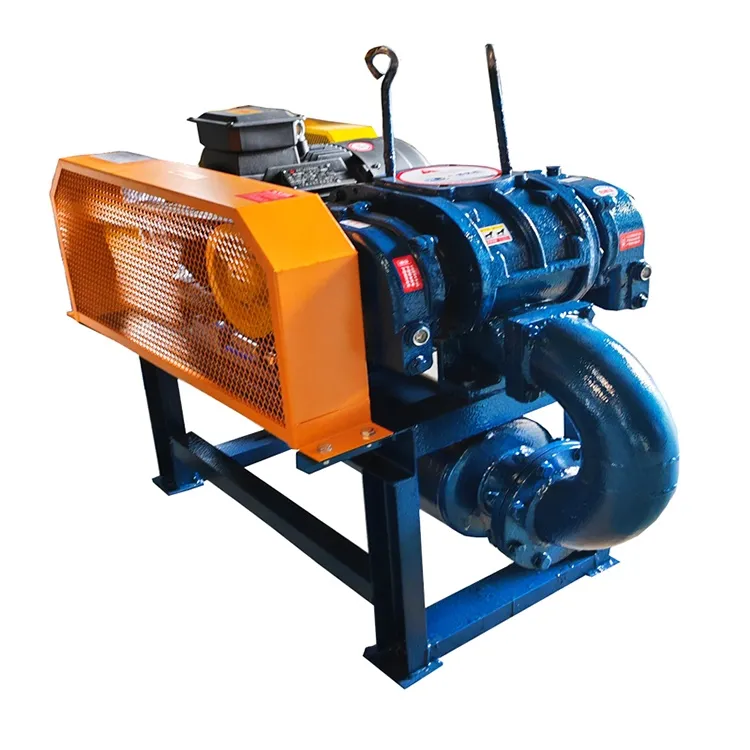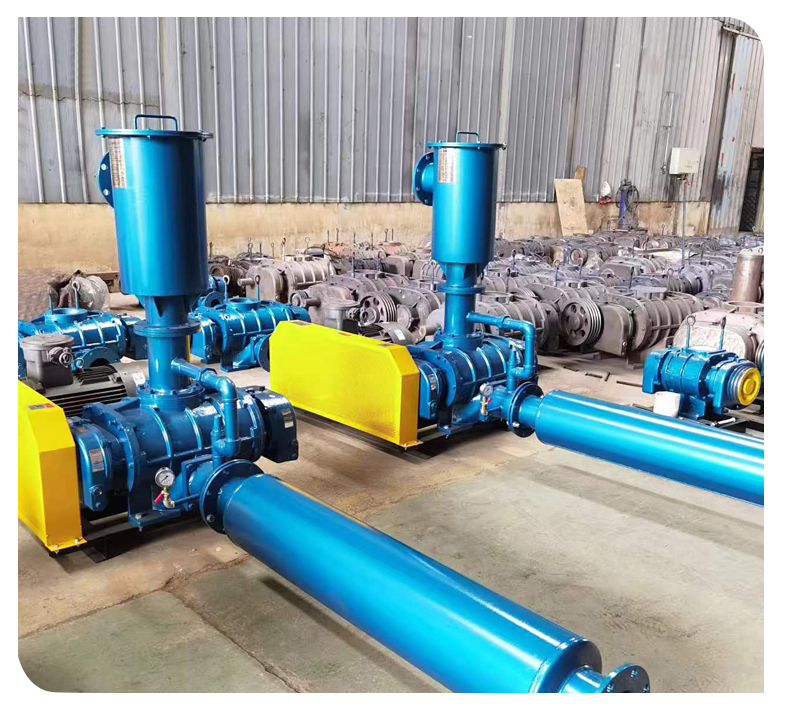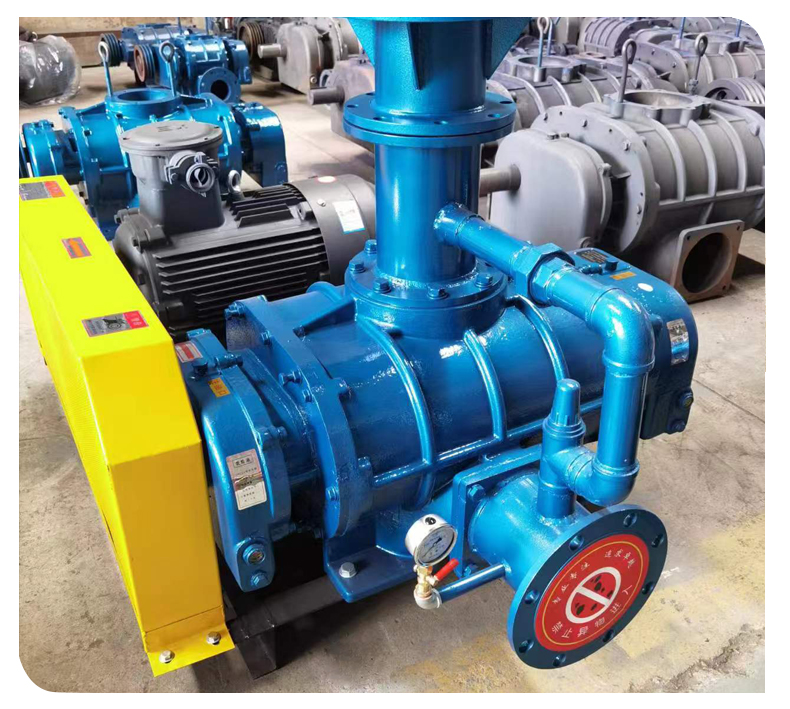
Although Roots blowers have advantages such as forced gas transmission, constant flow rate, and no oil pollution, their design features may become disadvantages under certain specific operating conditions, leading to decreased equipment efficiency, increased maintenance costs, and even inability to operate normally. The following are typical situations and reasons why Roots blowers are not suitable for use:
1、 High pressure ratio scenario (pressure ratio>2.1)
reason
Roots blower is an external compressor type, and gas compression mainly relies on the high-pressure gas reflux from the exhaust port, rather than the rotor directly doing work on the gas.
The single-stage pressure ratio is usually ≤ 1.7 (outlet pressure ≤ 1.5 times inlet pressure), with a maximum of only 2.1. If higher pressure is required, multiple stages need to be connected in series, but sealing between stages is difficult and efficiency significantly decreases.
typical scenario
High pressure gas transportation: such as natural gas long-distance pipelines (requiring pressure>5 MPa) and high-pressure gas cylinder filling (requiring pressure>20 MPa).
Industrial high-pressure processes: such as high-pressure reactor gas supply, high-pressure pneumatic crushing, etc.
alternative
Screw compressor: Internal compression design, single-stage pressure ratio can reach 3-5, higher efficiency.
Centrifugal compressor: suitable for ultra-high pressure ratio (>10) and high flow scenarios, such as natural gas compression stations.
2、 Large flow variable operating condition scenario (flow fluctuation>± 20%)
reason
The flow rate of Roots blower is only related to the speed and geometric dimensions, and cannot be controlled by adjusting the outlet valve (otherwise it may cause motor overload or fan surge).
Although variable frequency speed regulation can adjust the flow rate, the speed range is limited (usually 70% -100% of the rated speed), and the efficiency decreases at low speeds.
typical scenario
Processes that require frequent adjustment of flow rate, such as chemical reactor gas supply and boiler combustion control.
Occasions with significant seasonal load changes, such as fluctuations in air demand for heating boilers during winter.
alternative
Centrifugal fan: By adjusting the inlet guide vanes or outlet valves, the flow control range is wide (50% -100%).
Multi stage centrifugal compressor: suitable for high flow and variable operating conditions scenarios, such as large air separation units.
3、 Containing a large amount of liquid or high humidity conditions (liquid to gas ratio>5%)
reason
The rotor and cylinder of the Roots blower are sealed with a micrometer level gap (0.1-0.5 mm). If the gas contains liquid or has high humidity, the liquid may seep into the gap, causing:
Rotor jamming or wear;
Emulsification failure of lubricating oil;
Exhaust nozzle spray (pollution system).
typical scenario
Wet dust removal system: such as calcium carbide furnace dust removal (containing a large amount of carbide slag slurry).
High humidity gas transportation: such as the steaming and cooking section of a paper mill (humidity>90%).
Gas liquid mixed transportation: such as sewage treatment plant sludge digestion gas (containing methane and water vapor).
alternative
Water ring vacuum pump: capable of transporting liquid containing gases, suitable for vacuum suction scenarios.
Screw compressor: Built in oil film seal, can withstand small amounts of liquid (liquid to gas ratio<1%). Centrifugal liquid ring compressor: specially designed for gas-liquid mixing, such as oil and gas mixing pumps. 4、 Ultra low flow or ultra-high pressure head small flow scenarios reason The minimum flow rate of Roots blower is limited by the geometric dimensions of the rotor, making it impossible to achieve ultra-low flow rates (<1 m ³/min). If the flow rate is forcibly reduced through variable frequency speed regulation, it will result in: Motor efficiency decreases (efficiency drops sharply below 50% speed); Gas flows back into the cylinder, generating high temperatures (which may cause thermal deformation of the rotor). typical scenario Laboratory precision gas supply: such as mass spectrometer carrier gas supply (flow rate<0.1 m ³/min). Microelectronics industry: such as supplying gas to vacuum chambers in chip manufacturing (requiring stable and extremely low flow rate). alternative Diaphragm pump: capable of achieving ultra-low flow rates of 0.001-10 m ³/min without oil pollution. Micro screw compressor: suitable for low flow, high pressure head scenarios, such as portable oxygen concentrators. 5、 High temperature gas scenario (intake temperature>80 ℃)
reason
The design of the clearance between the rotor and cylinder of Roots blower is based on normal temperature conditions, and high temperatures can cause:
Metal thermal expansion, gap narrowing or even jamming;
Lubricating oil oxidation failure (applicable temperature for ordinary mineral oil<80 ℃); Seal aging (such as rubber O-ring temperature resistance<120 ℃). typical scenario High temperature exhaust gas treatment: such as converter gas recovery in steel mills (temperature>150 ℃).
Drying process gas supply: such as drying chemical raw materials (inlet temperature>100 ℃).
alternative
High temperature centrifugal fan: Made of heat-resistant alloy material (such as Inconel 625), it can withstand gases at 200-400 ℃.
Steam compressor: designed specifically for high-temperature steam, such as MVR evaporation systems.
6、 A scenario that requires absolute leak free (leakage rate<10 ⁻⁶ Pa · m ³/s)
reason
Roots blowers rely on gap sealing and cannot achieve absolute leak free performance. The actual leakage rate is usually 10 ⁻³ -10 ⁻⁴ Pa · m ³/s.
If toxic, flammable or valuable gases (such as chlorine, hydrogen, helium) are transported, leakage may cause safety accidents or economic losses.
typical scenario
Nuclear industry gas supply: such as the supply of coolant for nuclear reactors (with a leakage rate of less than 10 ⁻⁹ Pa · m ³/s).
Semiconductor industry: such as high-purity gas transportation (with a leakage rate of less than 10 ⁻⁸ Pa · m ³/s).
Transportation of hazardous chemicals: such as pressurization of liquid chlorine storage tanks (requiring leak prevention design).
alternative
Diaphragm compressor: isolates gas and lubricating oil through a metal diaphragm to achieve zero leakage.
Magnetic driven centrifugal pump: No mechanical seal, suitable for transporting corrosive liquids.
7、 Noise sensitive scenarios (noise requirement<65 dB (A))
reason
The rotor engagement and gas backflow of Roots blower generate high-frequency noise (85-95 dB (A)), requiring additional installation of mufflers and soundproof covers.
If no noise reduction measures are taken, it may exceed environmental or occupational health standards (such as China’s “Industrial Enterprise Boundary Environmental Noise Emission Standards” which require ≤ 55 dB (A) at night).
typical scenario
Surrounding areas of hospitals and schools, such as the central oxygen supply system fan room in hospitals.
Precision laboratory: such as optical instrument calibration laboratory.
Near residential areas: such as the aeration fan room of a sewage treatment plant.
alternative
Low noise centrifugal fan: equipped with a rear tilting impeller and sound insulation design, the noise can be as low as 60-70 dB (A).
Oil free screw air compressor: Built in muffler, noise ≤ 75 dB (A), suitable for noise sensitive industrial scenarios.